Unlock 10% off – just for signing up!
Black Tea vs Green Tea

Black Tea vs Green Tea: Which Is Healthier and What’s the Difference?

Both black tea and green tea come from the same plant , Camellia sinensis , and yet they taste completely different and work differently in your body. If you’ve been wondering which to drink daily, the short answer is: it depends. Green tea edges ahead for antioxidants and calm focus; black tea wins on boldness, energy, and gut-friendly compounds.

Let’s break it down.

Key Takeaways

Where Do Green and Black Tea Come From

Where Do Green and Black Tea Come From?

As mentioned earlier, both types of tea grow from the same tea plant, that is cultivated primarily across China, Japan, India, and Sri Lanka. What makes green tea green and black tea black comes down entirely to tea processing.

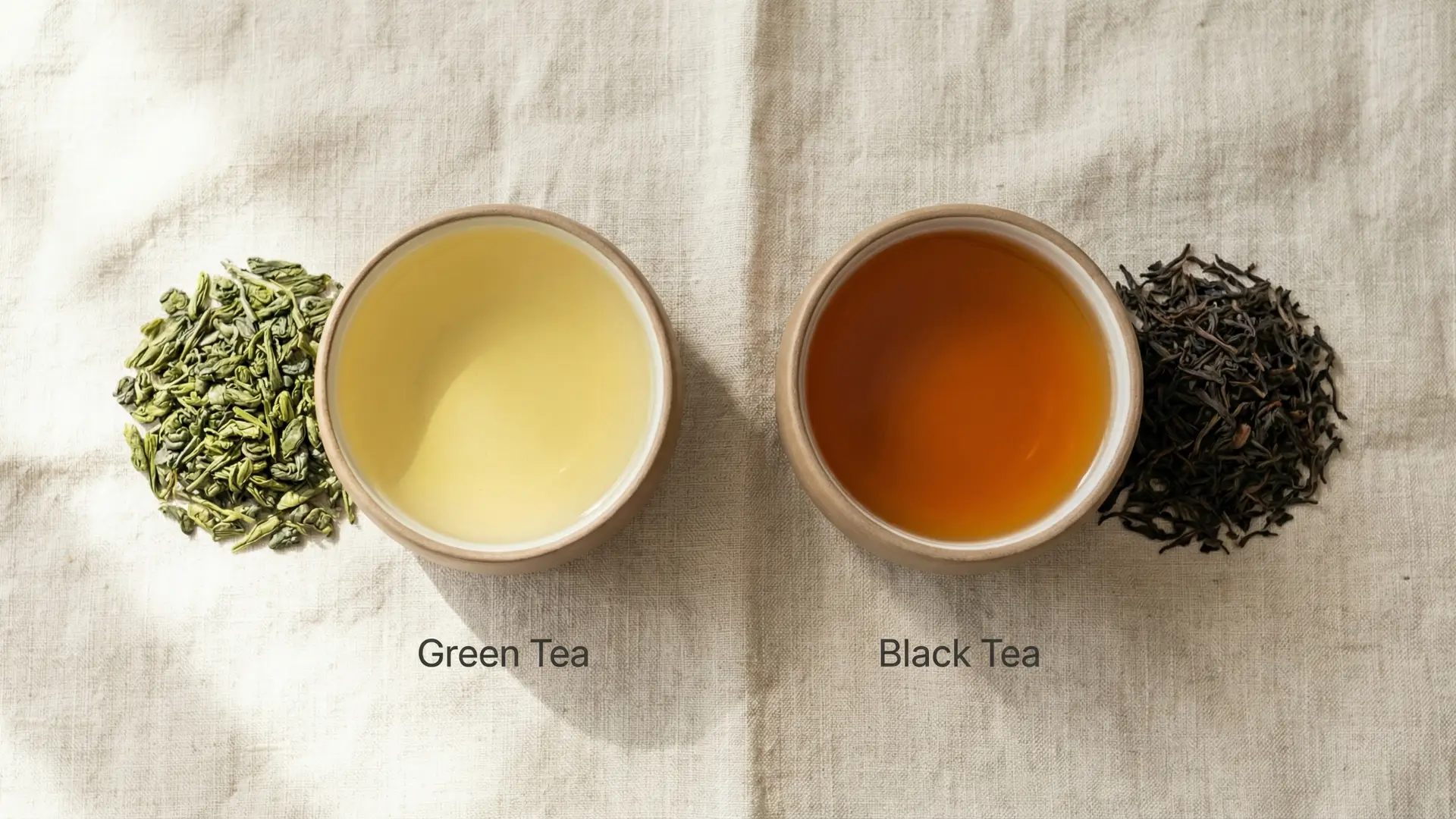
Green tea leaves are quickly steamed or pan-fired after harvest to stop oxidation. This preserves the bright green colour, the grassy aroma, and most of the original plant compounds. Japanese teas like sencha and matcha are steamed; Chinese green teas are typically pan-roasted. Black tea undergoes full oxidation — the leaves are rolled, exposed to air, and allowed to react with oxygen. Enzymes in the leaf trigger a chemical reaction that converts catechins into darker compounds called theaflavins, giving black tea its amber colour and robust flavour. Assam tea and Darjeeling tea from India are among the world’s most prized examples.
How Do Green and Black Tea Differ in Taste

How Do Green and Black Tea Differ in Taste?

Taste is one of the biggest reasons people pick one over the other.

Green tea offers a light, sometimes vegetal taste — grassy, sweet, or faintly seaweed-like depending on the variety. Japanese green teas tend to be umami-forward; Chinese green teas lean floral or nutty. A well-brewed cup is usually pale yellow-green.

Black tea is bold, malty, and occasionally astringent. The infusion pours a rich amber to deep brown, and the flavour holds up well against milk. Assam teas are earthy and strong; Darjeeling teas are more floral.

Brewing temperature matters too. Green tea is brewed at 70–80°C — too hot and it turns bitter. Black tea handles near-boiling water (90–100°C) and steeps for 3–5 minutes.

Caffeine Content — Black Tea vs Green Tea

Tea type Caffeine per cup (240 ml)
Black tea 40–70 mg
Green tea 20–45 mg
Matcha 60–80 mg
Coffee 80–120 mg
Black tea has roughly double the caffeine of green tea per cup, though both sit well below coffee. Caffeine levels also vary by variety, steeping time, and water temperature.

Both teas contain the amino acid L-theanine, which pairs with caffeine to promote calm, steady focus rather than the spike-and-crash of coffee. Green tea generally has a bit more of it, which partly explains why it feels gentler despite still being caffeinated.

Health Benefits of Green Tea

Green tea is rich in catechins — the most potent being epigallocatechin gallate (EGCG). These polyphenols are largely preserved because the leaves aren’t oxidised.

What the research says:
Health Benefits of Green Tea

Health Benefits of Black Tea

Black tea gets less attention in wellness conversations, but it’s far from nutritionally empty. Oxidation converts catechins into theaflavins and thearubigins — polyphenols with their own documented effects.

What the research says:

Green Tea vs Black Tea: Which Is Better?

Neither tea is objectively superior. They’re both good — just in different ways.
Go for green tea if you: Go for black tea if you:
Want the highest concentration of antioxidants (EGCG, catechins) Want a stronger caffeine hit to reduce your coffee intake
Are sensitive to caffeine but still want some focus Are looking to support gut health and cholesterol levels
Are focused on weight management or reducing oxidative stress Prefer a bold, malty flavour — especially with milk
Prefer a lighter, more delicate taste experience Want theaflavin-rich tea with real staying power
The association between green and black tea consumption and better health outcomes is well supported across multiple peer-reviewed studies. Drinking either regularly is better than drinking neither — and if you enjoy both, there’s no need to choose. If you enjoyed this, you might also like our breakdown of white tea vs green tea — another common comparison worth reading.

Frequently Asked Questions

Which is healthier, green or black tea?
Green tea edges ahead on antioxidants thanks to EGCG and catechins. Black tea counters with theaflavins and gut-supporting polyphenols. Both support heart health — neither is clearly superior across the board.
Black tea: 40–70 mg per cup. Green tea: 20–45 mg. Both sit below coffee (80–120 mg). Green tea’s L-theanine also softens the caffeine effect, making it feel less jittery.
Both are strong daily choices. Prioritise green tea for antioxidants and calm focus; black tea for gut health and a stronger morning lift. Drinking either consistently matters more than picking the “perfect” one.
They’re very different. Black tea is bold and malty — holds up well with milk. Green tea is lighter, sometimes grassy or floral. Most people form a clear preference once they’ve tried quality versions of both.
Both grow from Camellia sinensis. Green tea originated in China and Japan; black tea became prominent in India (Assam, Darjeeling) and the United Kingdom, where it remains a daily ritual.

Leave a Reply

Your email address will not be published. Required fields are marked *

GET 10% OFF ON SIGNUP!

Best Selling Range:

Related Articles