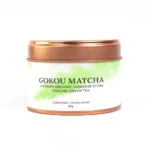
Despite the common name “matcha”, the correct name for Japanese powdered green tea is “mattia”, which literally means “ground tea”. This drink was invented in China, not in Japan, as is commonly believed. This tea was brought to Japan by Zen Buddhists, who turned the process of drinking matcha into a whole ceremony. Over time, this tea was forgotten in China, and in Japan, on the contrary, in the 14th-16th centuries it gained wide popularity among the noble strata of the population, and later became an integral part of Japanese culture.
In early April, the first shoots of Camellia sinensis, the tea plant, appear. Shortly thereafter, tea plantations dedicated to the cultivation of Matcha and Gyokuro teas are shaded for about 20 days using large frames of slats and rice rods that are placed over the plants. They do this in order to exclude direct sunlight and thus reduce the level of photosynthesis. The result is increased levels of theanine, an amino acid that gives the full-bodied taste of Matcha and Gyokuro teas. Exclusive Matcha tea is produced from homogeneous raw materials of the first harvest.
According to the traditional Japanese calendar, Risshun is the first day of spring in the year; Hachiju-hachiya is the 88th day after Rishshun. Hachiyuhachiya is a special day that marks the beginning of the first tea harvest of the year. Although this day comes at slightly different times from year to year, Hachiju-hachiya usually occurs in early May. At this time, the first flashes of tea leaves are carefully harvested. The first flash is the first harvest of young leaves of the year, which connoisseurs consider absolutely the best in quality, freshness, and taste.
88th Night (Hachiju-Hachiya) is a Japanese holiday that celebrates the start of the year’s first tea picking and harvest. This first flush of tea is known as shincha, which directly translates to “new tea.”
The key difference between Japanese green tea and other teas (black tea, oolong tea, Chinese green tea) is that Japanese tea leaves are steamed after harvest. The steaming process lasts about 15-80 seconds. This happens in the first 12-20 hours from the moment the leaves are harvested. The purpose of steaming is to prevent oxidation of the leaves. Thanks to this steaming, the natural green color of the leaves, aroma, and composition of nutrients are preserved. The color of the infusion is bright green, not yellow like Chinese green tea.
While Gyokuro and Sencha whole-leaf teas are tightly rolled after steaming, the leaves used to make Matcha are not rolled. Instead, they go through several stages in a large multi-chamber air machine where they are gently blown and cooled with a slow stream of air. Then they are spread evenly on a flat surface, where they are further dried. Before drying completely, the leaves pass through a drum-like machine where the stems and petioles are separated from the main leaf. What remains after drying is called Tencha. Tencha is the raw material for Matcha powder.
The final step in the production of Matcha is the grinding of Tencha into a fine powder. For 800 years, the traditional method for doing this was grinding in a manual stone mill. Today, automated stone mills are used. The result is the ultimate consistency of Matcha’s ultra-fine powder that Matcha lovers love. The production of tea powder (for exclusive tea) has remained the same as it was half a century ago – manually on millstones. This is a laborious and slow process that requires concentration and patience. On millstones (handmade), tea leaves (high-quality and without veins) are slowly ground to a state of powder. Obtaining very high-quality tea requires about 12 types of stones. The slower the leaves are ground, the more useful substances in the powder remain intact, and the better the resulting tea. It takes an hour of work on the millstones to obtain 40 g of powdered Matcha tea.
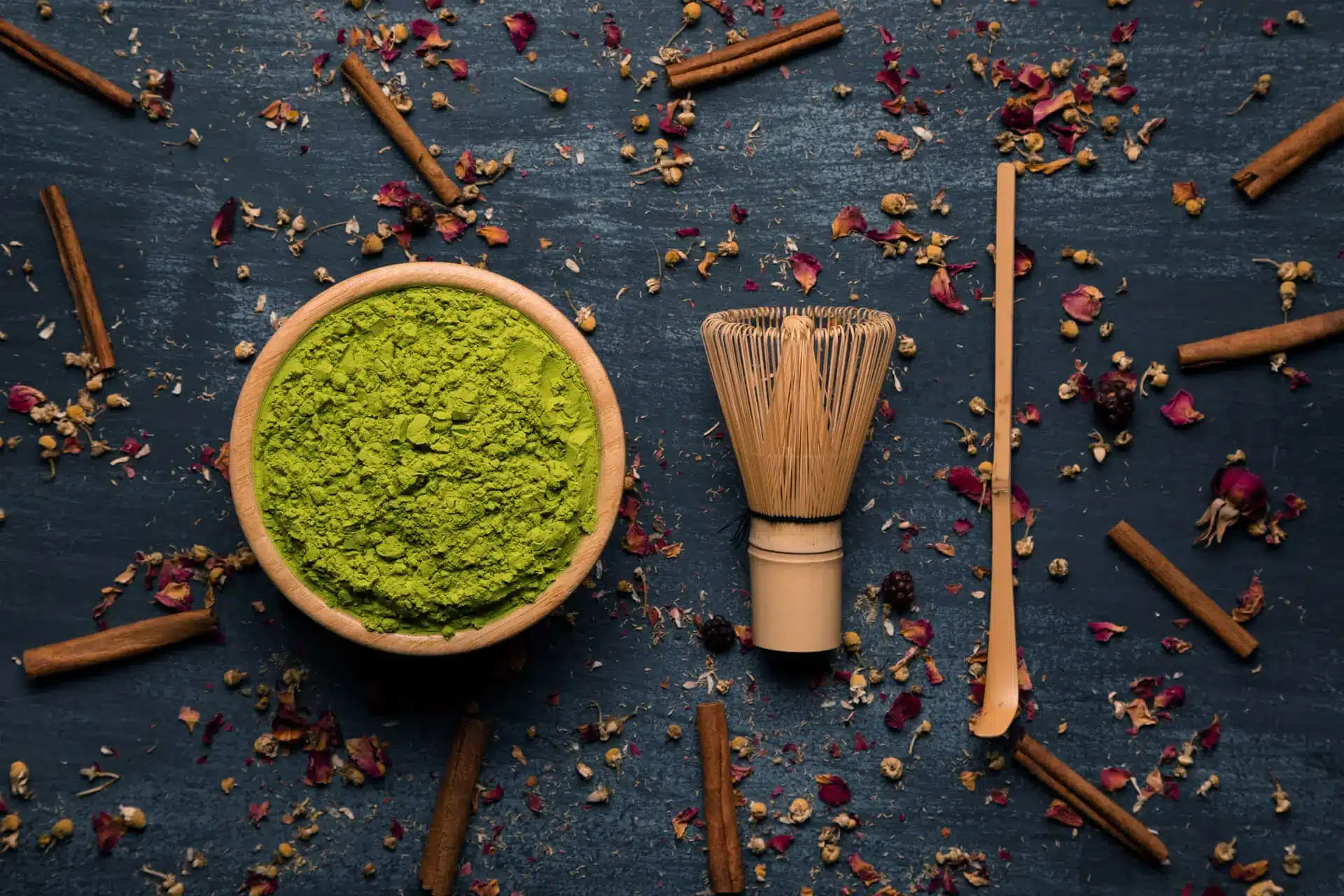
When preparing matcha, it is not brewed, but whipped into the foam with a special whisk – chasen (chasen). Not only the infusion is drunk, but also the powder of tea leaves itself. Based on the concentration of the powder, matcha can be used to make thick koi-cha tea or thin usu-cha tea. The first is consumed exclusively during the ceremony, while the second can be prepared anywhere. Matcha is used in the preparation of “tea ice cream”, iced tea, and cocktails.
One cup of Matcha replaces 10 cups of regular green tea, and thanks to its high antioxidant content, it promotes weight loss. For one serving, you need to take about 1.5 grams of powder. Until recently, matcha tea was not consumed almost anywhere except in Japan. In Japan, this tea is especially popular among students while preparing for exams, as it has excellent invigorating properties. But today matcha is gaining more popularity in Europe and North America.
This drink is sold not only in cafes and health food stores but is also often used as an additive or natural dye in the preparation of desserts and other dishes. Nowadays, Matcha tea has gained popularity all over the world and has been exported to many countries, although it is no longer the same Matcha that is drunk at Japanese tea ceremonies. Almost all varieties of Matcha on the market are tea blends consisting of five types of tea leaves collected on different plantations.
After all, the demand for this tea is huge, the amount of raw materials is limited, and the Japanese have found a way to satisfy the demand. For mass production, one of the components of the art of Matcha production is the ability to create a well-balanced blend. The fact is that each individual plantation has its own climatic conditions, its own soil characteristics, and, accordingly, the characteristics of agricultural technology.
This forms the nutritional, gustatory, and aromatic properties of tea raw materials growing on them. Therefore, in some fields, juicy and green leaves grow, but with a mild taste and aromatic properties, in others – a yellowish hue, but with excellent taste and aroma, in others – a high-quality leaf, but brittle and fragile. With the right combination of raw materials, a quite high-quality collection is obtained.
Matcha tea is far superior to regular green tea. Studies have shown that the level of EGCG antioxidants in matcha is 137 times higher than in regular green teas. Matcha contains the amino acid L-theanine, which is an uplifting and mood-stabilizing ingredient without the side effects of caffeine. Matcha contains an impressive 1,380 units of ORAC (Oxygen Radical Absorbance Capacity)—an indicator developed by the National Institute on Aging in Baltimore, Maryland. The USDA recommends an ORAC rate of 3,000 to 5,000 units per day. Thus, two to three cups of green Japanese matcha tea provides this amount. A 2008 study at the University of Mississippi showed that 60% of levels of EGCC present in matcha tea’s catechin (tannin) significantly reduced the risk of developing breast cancer.